Awards 2025
Submissions for the 2025 AGAPS awards are closed. This year's winners were announced at our annual Business meeting on November 22 at the annual MESA meeting.
Visit our 2024 awards page to see last year's winner and read their commendations.
2025 AGAPS Biennial Book Award Winner:
Dr. Crystal Ennis, Leiden University
Millennial Dreams in Oil Economies: Job Seeking and the Global Political Economy of Labour in Oman
(Cambridge University Press)
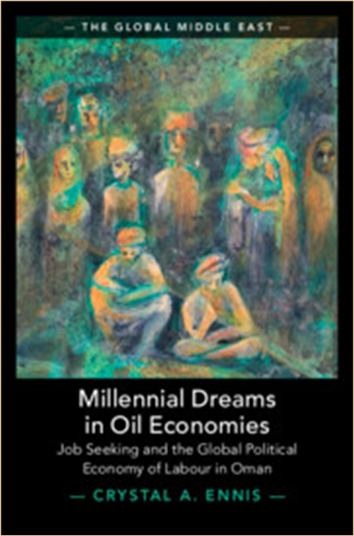
Grounded in the history and literature of Omani and global labor, this timely, thought provoking and brilliantly executed study re-centers our understanding of labor markets and citizenship in the Arabian Peninsula and Gulf region by bringing attention to the lives, experiences and aspirations of young Omanis. Shedding new light on class relations, rentier state and infrastructural expansion, and the tension between a saturated public sector and private enterprise, this fascinating book humanizes economic development by showing the influence of the practices and discourses of the government and corporate actors on labor governance, and their impact on youth resistance and mobilization. Mixing ethnography with an in-depth historical analysis and quantitative approaches Millennial Dreams in Oil Economies highlights the unmistakable tension between rentierism and neoliberalism in the Omani labor market, while making a powerful argument for a specific rentier neoliberalism that has emerged from youth experiences. This book is an outstanding example of the best literature produced on the Arabian Peninsula and Gulf region of late. Not only it opens new and exciting vistas on national and regional development paying careful attention to the differentiation between workers on the basis of citizenship, gender and age, but also contributes to illustrate global trends, placing Oman and its young workforce at the center of global capitalist development.
Honorable Mention:
Dr. Arang Keshavarzian, New York University
Making Space for the Gulf: Histories of Regionalism and the Middle East
(Stanford University Press)
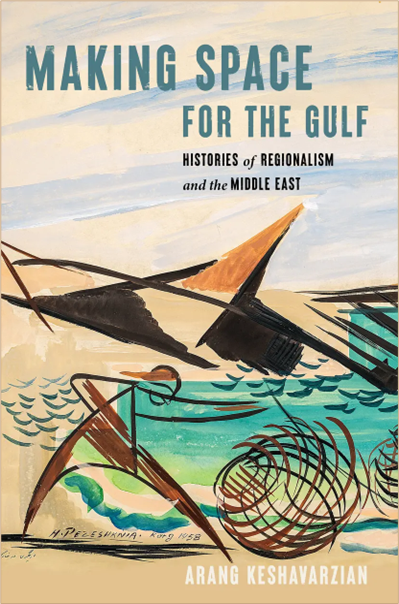
This eloquent study on the making and unmaking of Gulf regionalism since 1800 offers a fresh, multi-layered, interdisciplinary and theoretically informed re-interpretation of the history and political economy of the Arab/Persian Gulf region. This volume is a powerful endeavor to thoroughly recraft scholarly perceptions of this region in ways that break down nationalist assumptions. Using space and scale as main analytical framework and drawing on critical geopolitics, Making Space for the Gulf highlights the historical intersections of the complex imperial, social and capitalist geographies of the region, threading a new path for our understanding of Gulf regionalism. This is a story of regional aggregation and disaggregation that has connected the Arab to the Iranian worlds, and the Gulf coast to their hinterlands for more than two centuries: from the creation of Britain’s informal empire, to its incorporation into global trade networks of pearls and dates, and then finally the development of the oil industry, the creation of the nation-states and of modern urban landscapes. This groundbreaking book reminds us that regionalism is not an abstract concept created by area studies as a field of academic knowledge, but a lived socio-political reality that has evolved in time and space.
2025 AGAPS Gwenn Okruhlik Dissertation Award Winner
Dr. Ahmed Yaqoub AlMaazmi, Princeton University
An Enchanted Sea: Occultism, empire, and society in the Western Indian Ocean, 1450-1750
An Enchanted Sea is a highly original and compelling thesis that examines the history of the occult in the Indian Ocean during the period of the Yaʿrubi Imamate in Oman. The thesis shows how the Ya’rubi institutionalised the occult sciences and utilised them through daily practices and objects in order to facilitate empire building. The project allows a revision of understandings of Oman and the Arabian Peninsula and its relationship with the Indian Ocean. In doing so the thesis makes a contribution to the historiography of global early modernities, shedding new light on non-Eurocentric knowledge production. The committee was very impressed with the originality of the thesis. Using manuscripts from archives in Oman the thesis weaves a story that encompasses multiple layers, actors and entwined currents of knowledge production in a structure that is well-written and analytically clear. In doing so the thesis responds to a significant lacuna on the Ya’rubi Imamate and the history of the occult in the Arabian Peninsula and Indian Ocean. The thesis embodies a methodology that recasts Oman as a country that is at the centre of flows of ideas, practices and empire that extended far across the Middle East and Indian Ocean.
Honorable Mention:
Dr. Gabriel Young, New York University
State, Land, and Labor in the Making of an Iraqi Periphery: Basra, 1921-1963
Dr. Young’s thesis examines the way in which Basra and its environs were reshaped by the shift from an agrarian economy to an oil frontier. The thesis allows an understanding of Basra that illustrates how the development of the oil sector was contested and shaped by confrontations between the rural classes of peasants and landlords. Using archival research, the thesis offers a new means to understand how Basra was transformed into an extractive zone. It sheds light on the way that extractive economies are developed through a close interaction with state formation projects and social and environmental reorganisation.
2025 Award Committee Members
Prof. Nelida Fuccaro, Prof. Tim Niblock & Prof. Amal Sachedina
Dr. Nadeen Dakkak, Dr. Christian Henderson & Dr. Hsinyen Lai